The short version
BPC-157 and TB-500 are the two peptides most often discussed in preclinical tissue-repair research. They come from completely different sources and are studied through different mechanisms, which is exactly why researchers frequently investigate them together — most commonly as the Wolverine blend.
| BPC-157 | TB-500 | |
|---|---|---|
| Origin | Partial sequence of a protein found in gastric juice | Based on thymosin beta-4, a protein found in most cells |
| Size | 15 amino acids | Short fragment of a 43-amino-acid protein (see below) |
| Main research themes | Angiogenesis, nitric-oxide signalling, tendon, ligament and gut models | Actin regulation, cell migration, wound and muscle models |
| Evidence base | Mostly rodent and cell studies | Mostly cell and animal studies |
What is BPC-157?
BPC-157 (“Body Protection Compound-157”) is a synthetic 15-amino-acid peptide whose sequence was derived from a larger protein isolated from gastric juice. An unusual property is its stability in gastric conditions, which is part of why it has been studied in gastrointestinal models.
Most of the published work comes from preclinical studies — largely rodent models — examining tendon, ligament, muscle and gut tissue. Researchers have investigated its relationship with blood-vessel formation (angiogenesis), the VEGF receptor pathway and nitric-oxide signalling. Controlled human data remain very limited, which is important context when reading claims about it online.
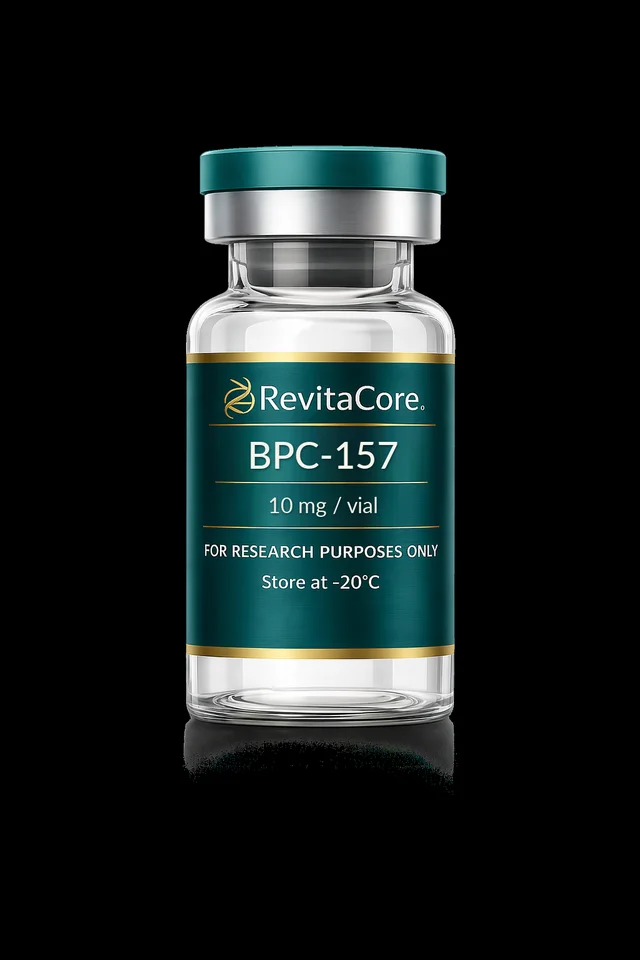
RevitaCore supplies BPC-157 10 mg as a lyophilized research material.
What is TB-500?
TB-500 is a synthetic peptide modelled on thymosin beta-4 (Tβ4), a 43-amino-acid protein present in almost every cell type. Tβ4’s best-understood job is binding actin — the protein that forms the cell’s internal scaffolding — which makes it central to how cells change shape and move.
The name “TB-500” is most often used for a short fragment corresponding to Tβ4’s actin-binding region, though some suppliers use it for the full-length peptide. That’s one reason a Certificate of Analysis matters: the measured molecular mass tells you which one you have.
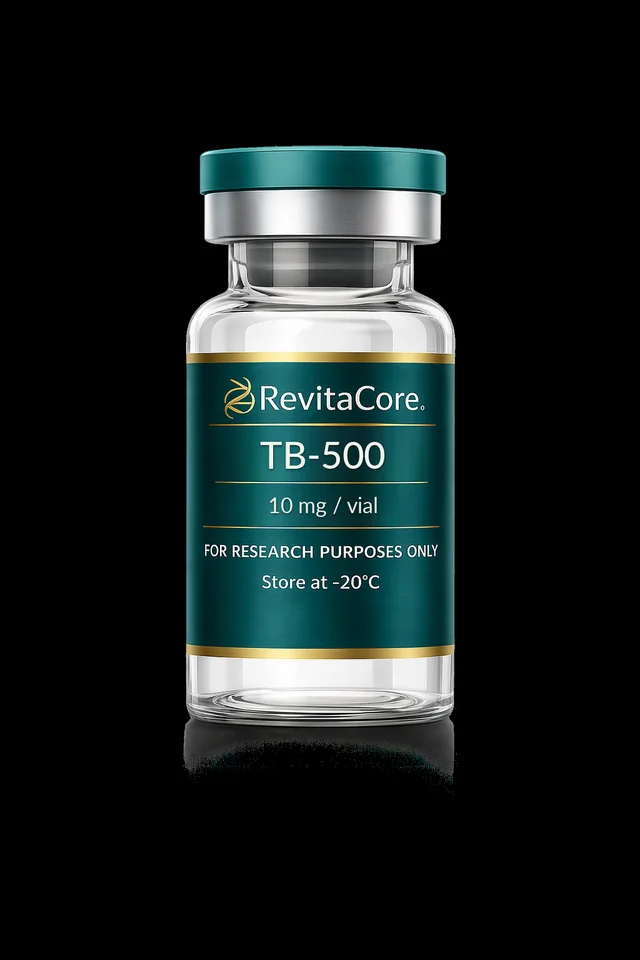
Research on Tβ4 and TB-500 focuses on cell migration, new blood-vessel formation and wound and muscle repair models. See TB-500 (Thymosin Beta-4) 10 mg.
How they differ in the lab
- Mechanism. BPC-157 research centres on growth-factor and nitric-oxide signalling; TB-500 research centres on actin dynamics and cell migration.
- Source. BPC-157 is derived from a gastric protein; TB-500 from a ubiquitous intracellular protein.
- Models. BPC-157 appears heavily in tendon, ligament and gastrointestinal models; TB-500 in wound-healing, muscle and cardiac-tissue models.
- Size. Both are short peptides, but their molecular masses differ, so they are easy to tell apart by mass spectrometry.
Why they are often studied together
Because the two act through different pathways that both feature in tissue repair, researchers often look at them in the same models to compare or combine effects. That’s the idea behind pre-mixed blends:
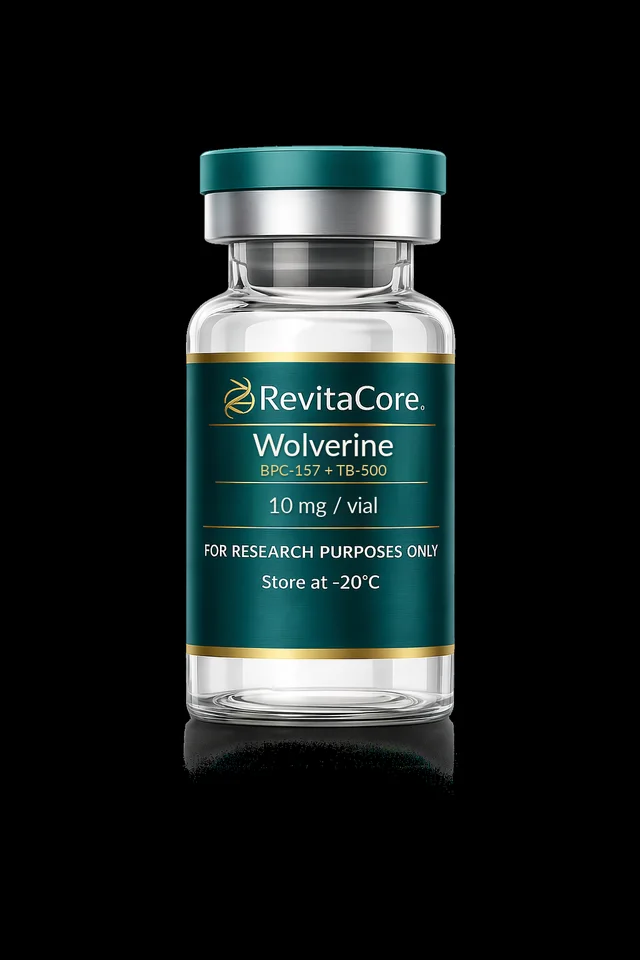
- Wolverine — BPC-157 5 mg + TB-500 5 mg in one vial.
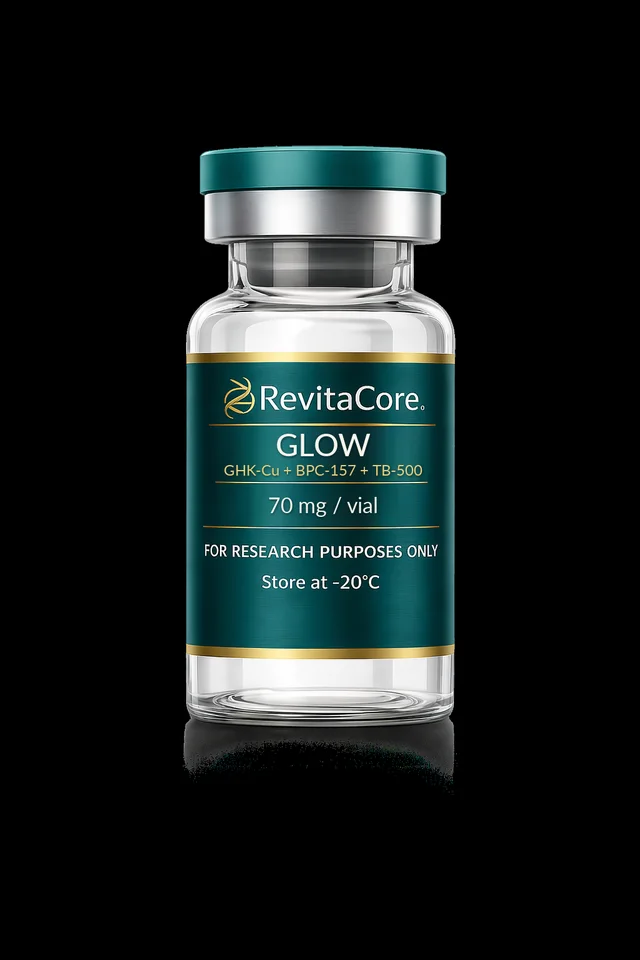
- GLOW — adds GHK-Cu 50 mg for extracellular-matrix research.
- KLOW — GLOW plus KPV for inflammatory-signalling models.
Read our full comparison: GLOW vs KLOW vs Wolverine.
A note on sport
Both BPC-157 and TB-500 appear on the World Anti-Doping Agency’s prohibited list. Neither is approved by Health Canada for human use. RevitaCore supplies both strictly as laboratory research materials.
Frequently asked questions
Is BPC-157 the same as TB-500?
No. BPC-157 is a 15-amino-acid peptide derived from a gastric protein; TB-500 is based on thymosin beta-4. They are studied through different mechanisms.
What is the Wolverine blend?
A research blend containing BPC-157 and TB-500 in one vial. RevitaCore’s Wolverine vial contains 5 mg of each.
Can I buy BPC-157 and TB-500 in Canada?
Yes. RevitaCore ships both, and the Wolverine blend, from British Columbia across Canada as research materials.